
What Is Cryotherapy? A Commercial Guide for Gyms
What is cryotherapy? Cryotherapy is a controlled cold-exposure service delivered through equipment such as whole-body chambers or localized cold-air systems. In a commercial gym, it is not simply a machine purchase. It is a recovery-oriented member experience that must fit the facility’s space, electrical and ventilation plan, staff workflow, positioning, and revenue model.
Book a Strategy Call to evaluate cryotherapy for your facility.
What Is Cryotherapy in a Commercial Setting?
Cryotherapy in a commercial setting is the planned delivery of short, repeatable cold-exposure sessions as part of a gym’s broader recovery and wellness offer. The operator selects a system, creates a safe operating procedure, trains the team, defines the member experience, and measures whether the service earns its floor space.
That business context separates commercial cryotherapy from a consumer search for a session. A gym owner has to make a category decision. Is the service an anchor offer that helps differentiate the facility? Is it a supporting service that makes a larger recovery room more valuable? Or is another modality a better fit for the facility’s demand, footprint, and staff capacity?
The answer depends on the operating model, not on the coldest specification in a product brochure. ROI In Wellness frames modality planning around utilization, revenue per square foot, pricing, programming, staff training, and measurement. Its commercial modality profiles provide the right starting point for comparing cryotherapy with other equipment categories.
How Does Commercial Cryotherapy Work?
Commercial cryotherapy equipment creates a controlled cold environment or directs cold air toward a specific area. A whole-body chamber surrounds most of the participant’s body, while a localized system delivers cold air to a selected area. The equipment manages temperature, session settings, controls, and safety features according to the manufacturer’s operating instructions.
The operating sequence is straightforward, but the business system around it deserves more attention. A typical commercial session requires a clear arrival point, participant preparation, equipment setup, staff oversight, session completion, cleaning or reset, and rebooking. Each handoff affects throughput and the experience members associate with the gym.
Operators should ask vendors to demonstrate the complete session workflow rather than showing only the equipment. Request the written operating instructions, training requirements, maintenance schedule, utility needs, emergency procedures, and service response process. These documents help the owner compare systems on operational fit rather than on a single temperature claim.
Electric and nitrogen-based systems
Electric and nitrogen-based systems use different methods to produce the cold environment. Electric systems use refrigeration components and do not require on-site liquid nitrogen storage. Nitrogen-based systems use a supplied cryogenic gas and require a facility plan for delivery, storage, handling, ventilation, and staff procedures.
This is a planning distinction, not a universal ranking. Electric equipment may simplify supply logistics for some facilities, while a nitrogen-based system may fit a different operating model. The right choice depends on the building, utilities, local requirements, service access, throughput goals, and the team responsible for daily operation.
For a current example of an electric whole-body system, review the Antarctica Barrel electric cryotherapy chamber. The product page describes its electric, nitrogen-free design and commercial control features. Treat the page as a product reference, then confirm every specification, installation requirement, and service requirement with the vendor before making a purchase decision.
What Are the Main Types of Cryotherapy Equipment?
The two broad commercial equipment formats are whole-body cryotherapy systems and localized cryotherapy systems. They can serve different roles in a facility, so an owner should not treat them as interchangeable versions of the same service.
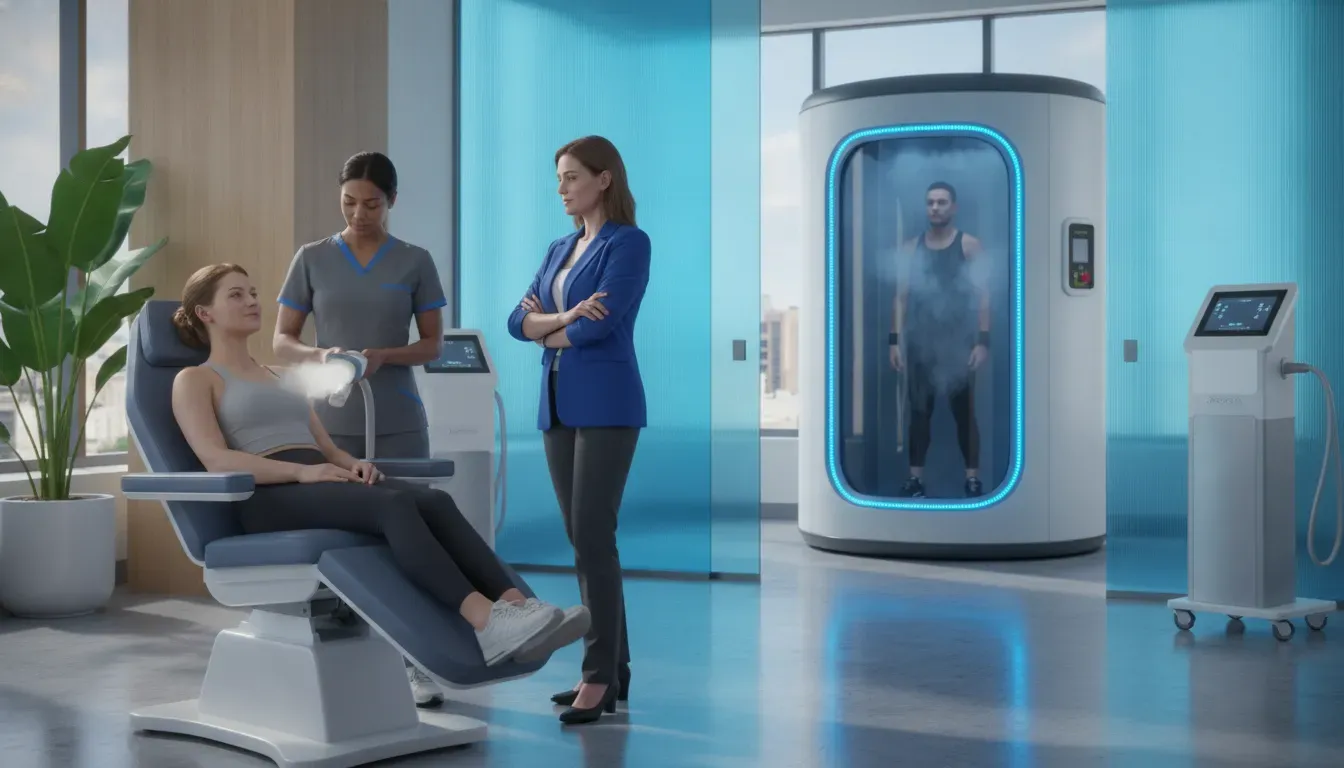
Commercial cryotherapy formats at a glance
- Whole-body chamber: delivers a full-body cold-exposure session in a dedicated chamber and may serve as a premium anchor. Confirm demand, footprint, utilities, and the operating plan.
- Localized system: directs cold air toward a selected area and can work as a flexible add-on. Confirm how the team will integrate it into programming and session flow.
- Electric configuration: uses refrigeration-based cold generation and may simplify supply planning where nitrogen logistics are not desirable. Confirm electrical capacity, clearance, heat output, and service access.
- Nitrogen-based configuration: uses supplied nitrogen and may suit facilities with the necessary supply and handling infrastructure. Confirm storage, ventilation, delivery, training, and local requirements.
The equipment format should follow the service concept. A whole-body chamber is a visible hero asset, but it also creates a more defined appointment experience. A localized system may fit a smaller or more flexible service area, but its commercial value depends on how clearly the staff can package and schedule the experience.
ROI In Wellness’s live commercial equipment catalog shows both whole-body and localized cryotherapy options. The Iceberg localized cryotherapy machine is a useful reference when comparing a portable, targeted format with a dedicated whole-body chamber. Product features are only one input. The facility’s category position and delivery model matter just as much.
How Can Cryotherapy Support a Gym’s Revenue Model?
Cryotherapy can support a gym’s revenue model when the service is positioned, scheduled, and measured as part of a complete member offer. The equipment itself does not create revenue. Revenue comes from a clear service promise, a price members understand, reliable delivery, repeat usage, and a team that can explain the offer without making unsupported promises.
Operators commonly evaluate several commercial roles:
- Premium add-on: attach a cryotherapy session to a higher-value membership or recovery package.
- Standalone session: sell a scheduled service to members who want a distinct recovery experience.
- Membership tier: include a defined number of sessions in a premium plan with clear booking rules.
- Performance program: integrate the service into a structured training or recovery pathway.
- Facility differentiator: use the equipment to make the gym’s wellness ecosystem easier to explain and remember.
The operator should test each model against actual capacity. A service that looks attractive on a menu can still underperform if it is difficult to book, poorly introduced, or unavailable during the hours members want it. The planning questions are practical: How many sessions can the team deliver? Who owns the schedule? What happens during staff changes? How will the facility measure usage, rebooking, revenue per session, and member feedback?
A commercial cryotherapy plan should also separate observed performance from planning assumptions. Use the ROI Calculator to model a facility’s inputs, then pressure-test the assumptions before making a capital decision. The calculator is an estimation tool, not a promise of results.
Talk with ROI In Wellness about a cryotherapy utilization and pricing plan.
What Space, Power, and Safety Questions Should Operators Ask?
Space and infrastructure decisions should happen before an operator commits to a chamber. A system that fits physically may still create problems with electrical capacity, heat rejection, clearances, delivery access, or participant circulation. Draw the proposed room at scale and review the full operating path from arrival to reset.
Space and workflow
- Where will a participant check in, prepare, and exit without interrupting other gym traffic?
- Can staff see or reach the equipment when the session is underway?
- Is there enough clearance for delivery, maintenance, cleaning, and emergency access?
- Does the room support privacy, a professional member experience, and clear wayfinding?
- Will the equipment reduce the capacity of another service that already performs well?
Power and building requirements
Ask the manufacturer for a complete utility and installation sheet. Confirm voltage, amperage, dedicated circuits, ventilation or heat-management needs, floor loading, clearances, drainage, network requirements, and delivery dimensions. Do not rely on a sales conversation or a generic product image to confirm building fit.
Operating safeguards
Every commercial facility needs written operating procedures that match the exact equipment model. Those procedures should cover pre-session checks, participant screening under the vendor’s policy, staff supervision, emergency stop use, incident documentation, cleaning, maintenance escalation, and service contact details. The team should know what it can handle internally and when it must stop operation and contact the vendor.
Nitrogen-based systems require additional planning for supply, storage, ventilation, and staff handling. Electric systems remove some supply tasks but still require model-specific electrical, clearance, heat, and maintenance review. In either case, the owner should confirm applicable local building, fire, workplace, and business requirements with qualified local professionals before installation.
What should a vendor proposal include?
A useful proposal should let an owner compare the complete operating commitment, not just the equipment price. Ask for the exact model, included accessories, delivery scope, installation assumptions, utility requirements, warranty terms, maintenance schedule, training hours, consumables, service response expectations, and any recurring software or support fees. Request a written list of exclusions as well. Missing construction, electrical, ventilation, freight, or staff-training costs can distort the early business case. A complete proposal also makes later financing, launch, and utilization decisions more grounded and easier to explain to partners.
Ask the vendor to walk through a normal session and an exception scenario, such as a control fault, delayed service visit, or equipment shutdown. The goal is not to predict every issue. It is to understand who owns each decision and how quickly the facility can return to a consistent member experience.
Is Cryotherapy Right for Your Facility?
Cryotherapy may fit a facility that has a defined member segment, enough demand for scheduled sessions, a team capable of consistent delivery, and a clear reason for adding a premium recovery service. It may not fit a gym that is still struggling to use its existing recovery equipment, has no owner for the schedule, or cannot support the infrastructure and training the system requires.
Use these questions to decide whether to advance the project:
- Who is the buyer? Identify the member segment, training population, or premium tier that will use the service.
- What job does the service perform? Define the experience in business language, such as differentiation, add-on revenue, or recovery-room programming.
- Can the facility create demand? Map the launch plan, staff scripts, scheduling process, and rebooking path before installation.
- Can the team deliver consistently? Assign ownership for opening checks, session flow, cleaning, documentation, and escalation.
- Does the room support the system? Confirm utilities, access, clearances, circulation, and maintenance space with the vendor.
- What will be measured? Set targets for utilization, revenue per session, rebooking, member adoption, and operating issues.
For a deeper equipment-selection framework, see ROI In Wellness’s commercial cryotherapy chamber buying guide. That guide covers selection, throughput, service, total cost of ownership, and payback modeling. This article stays focused on the definition, operating formats, and business questions that should come before a detailed comparison.
Book a Strategy Call to map the right cryotherapy role for your gym.
Frequently Asked Questions
What is cryotherapy used for in a gym?
In a gym, cryotherapy is used as a scheduled recovery and wellness service that can support member programming, premium packages, and facility differentiation. The operator should define the service around a clear member experience and business process rather than presenting equipment specifications as the offer.
What is the difference between whole-body and localized cryotherapy?
Whole-body cryotherapy uses a dedicated chamber for a full-body cold-exposure experience, while localized cryotherapy directs cold air toward a selected area. Whole-body systems typically create a more defined anchor service, while localized systems can offer a flexible supporting service. The best format depends on demand, space, staffing, and facility positioning.
Are electric cryotherapy chambers different from nitrogen-based systems?
Yes. Electric chambers use refrigeration components, while nitrogen-based systems use supplied cryogenic gas. The difference affects supply planning, storage, ventilation, training, installation, and ongoing operations. Operators should compare the complete building and service requirements for the exact models under consideration.
How should a gym evaluate cryotherapy equipment?
A gym should evaluate cryotherapy equipment by commercial fit, not by temperature alone. Review the service format, session workflow, throughput, footprint, utilities, safety procedures, staff requirements, maintenance, support, and measurement plan. Then model demand and operating assumptions through the ROI Calculator before committing capital.
Does cryotherapy guarantee a return on investment?
No. Cryotherapy equipment does not guarantee revenue, utilization, or payback. Results depend on the facility’s demand, positioning, pricing, programming, staff execution, operating costs, and member adoption. Use a facility-specific model as an estimate and validate the assumptions with a strategy conversation before purchase.