
Cryotherapy Benefits for Gyms: A Practical Operator Guide
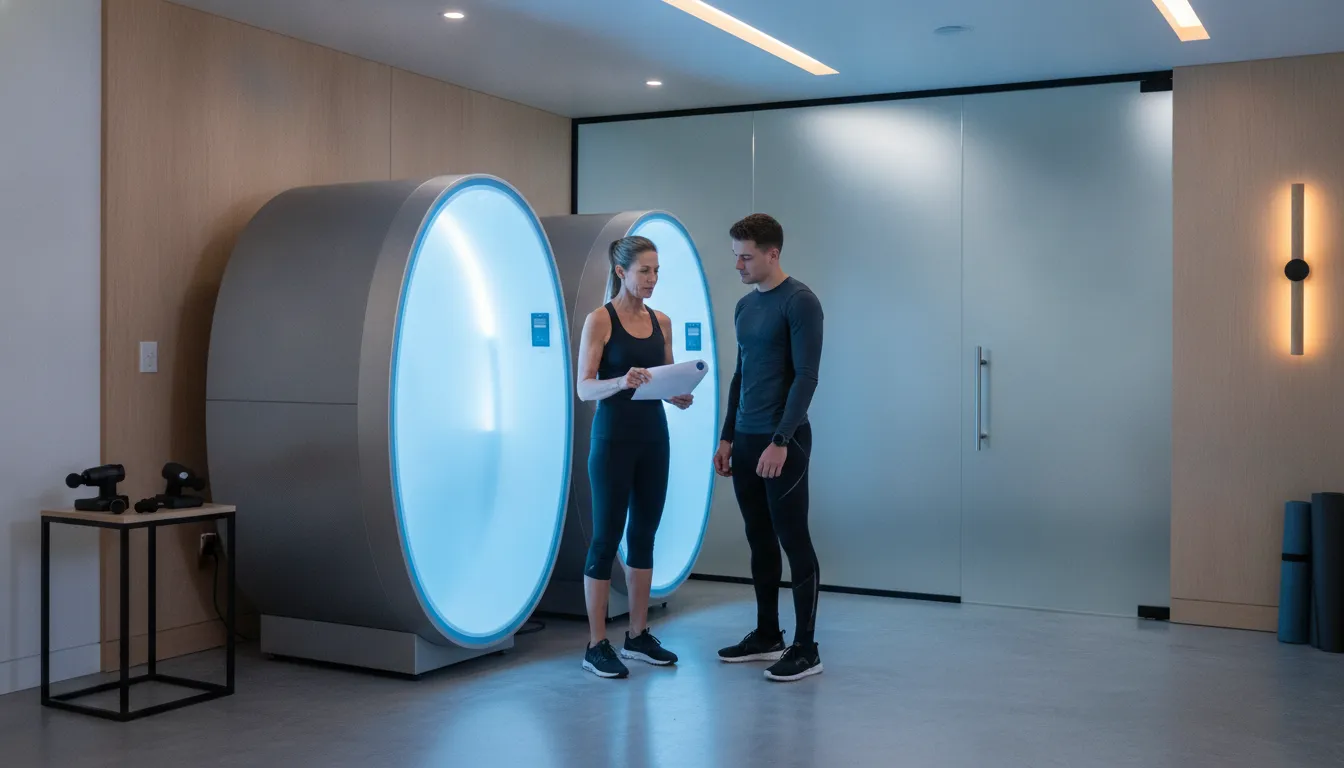
Cryotherapy creates business value when members use it, staff deliver it consistently, and operators measure the result.
For boutique studios and mid-market gyms, that makes cryotherapy a programming decision, not simply an equipment purchase.
The potential cryotherapy benefits for gyms include a differentiated recovery experience and stronger opportunities for structured programming. Operators can also evaluate the service through utilization, revenue per session, and retention impact. Research findings are mixed, so validate demand instead of promising a universal result.
The strongest business case connects the modality to a broader recovery ecosystem, clear staffing expectations, and a measurement plan. That is the foundation of business-first wellness design, where member experience and facility economics are considered together. For the broader Cryotherapy Equipment for Commercial Fitness Facilities planning framework, see this operator buying guide. Book a Strategy Call to discuss how the opportunity fits your facility, then examine what the benefit looks like in an athletic recovery program.
What Cryotherapy Benefits for Gyms Can Look Like in an Athletic Recovery Program
For a gym operator, the relevant question is not whether cryotherapy produces a universal result. It is whether the modality can support a better-designed athletic recovery program and a more valuable member experience when it is appropriately positioned, staffed, and measured. Potential outcomes should be framed as program possibilities, not promises.
A recovery experience members can understand
Research has examined whole-body and partial-body cryotherapy as recovery strategies following exercise. Studies have considered perceived soreness, muscle performance, and other markers after exercise-induced muscle damage. One review compared whole-body and partial-body approaches. Another assessed whole-body cryotherapy against passive recovery and options such as cold-water immersion, contrast-water immersion, active recovery, and infrared therapy. The Cochrane review assessed potential benefits and harms. This is an important reminder to present evidence with appropriate limits.
In practical terms, a well-run program may give members a structured recovery touchpoint after demanding training. That can contribute to a stronger sense of support, consistency, and progression around their training routine. It does not establish that every member will experience the same benefit. And it should never be described as a guaranteed performance result or a substitute for individualized professional guidance.
What the evidence can and cannot tell an operator
The findings are useful for shaping questions, not writing guarantees. A runner study compared cold-water immersion, contrast-water therapy, and whole-body cryotherapy using a crossover design with 12 male middle- and long-distance runners. Researchers applied the interventions immediately after exercise and at later time points, then measured several perceived and performance-related outcomes. Its conclusions may inform further program discussion, but the study population and design do not justify assuming identical results for every gym member or training population. Read the runner study for its methods and limitations.
That evidence boundary has an operational benefit: it encourages operators to define the intended member experience before investing. Track adoption, repeat participation, feedback, and utilization alongside any approved wellness or performance measures. If the program cannot earn consistent use or fit cleanly into the facility’s staffing and scheduling model, the equipment alone will not create a meaningful outcome. The strongest case for cryotherapy is therefore not a sweeping claim. It is a measured role inside a broader recovery system, with expectations that remain specific, supportable, and open to review.
Why Cryotherapy Benefits for Gyms Depend on the Right Modality Stack
A cryotherapy unit should not be evaluated as an isolated purchase. Its operator value depends on how well it fits the rest of the recovery experience, the facility footprint, and the way members move through the business. A standalone service can create interest. But a coordinated modality stack gives staff more ways to serve different member goals without asking one piece of equipment to carry the entire program.
Build complementary pathways, not a catalog of equipment
Start by mapping the jobs your recovery program needs to perform. Cryotherapy may serve members looking for a brief, high-impact recovery experience, while compression, contrast therapy, infrared, red light, vibration, or other modalities can support different preferences and scheduling patterns. The goal is not to acquire every available technology. It is to choose complementary services that reduce redundant purchases and create practical cross-utilization.
For example, a member might enter through a post-training recovery offer, then discover another service that better fits a different training day or time constraint. That flexibility can make the recovery area more useful across the week. It also gives the team more than one programming lever when demand for a single modality fluctuates. ROI In Wellness maintains a fitness recovery and athletic performance protocol collection that illustrates this broader equipment mix for fitness operators. Use the Cryotherapy Equipment for Commercial Fitness Facilities buying framework when comparing facility fit, throughput, and operating requirements.
| Operator question | What to evaluate |
|---|---|
| Who is the service for? | Member segments, training context, and the experience the program is designed to support. |
| How will it fit? | Footprint, traffic flow, supervision, cleaning, storage, and electrical requirements. |
| How will it perform? | Utilization, revenue per session, cross-use, feedback, and retention patterns. |
Design the stack around space, staffing, and measurement
Footprint matters because a recovery area must work within the facility members already use. Before selecting equipment, map traffic flow, privacy needs, storage, electrical requirements, cleaning responsibilities, and the amount of staff attention each service requires. A compact modality that can be scheduled alongside existing training activity may produce more practical utilization than a larger installation that is difficult to supervise or explain.
Programming should then connect the equipment to clear member segments and operational moments. Consider who is most likely to use the service, when capacity is available, how staff introduce it, and which adjacent offerings can be presented without creating confusion. Avoid prescribing a universal sequence or frequency. The right design depends on the equipment, facility, staffing model, and qualified operating guidance.
Finally, measure the stack as a system. Track utilization by modality, revenue per session or package, member adoption, cross-use between services, feedback, and retention impact. If cryotherapy attracts attention but the surrounding services remain empty, the problem may be programming or onboarding rather than equipment quality. A modality stack earns its place when it supports a coherent member experience and gives the operator useful data for improving revenue per square foot.
How Should Gyms Program Cryotherapy for Different Member Segments?
A cryotherapy offering becomes commercially useful when it is programmed around specific member needs, operating constraints, and buying behavior. The objective is not to give every member the same experience. It is to create clear offers that staff can explain, schedule, and measure without turning the recovery floor into an unmanaged add-on.
-
Define segments by use case and business value
Start with observable member groups rather than broad labels. One segment may be athletes who want a structured recovery add-on around training. Another may be members seeking a premium recovery experience as part of a broader membership. A third may be personal-training clients whose coaches can integrate recovery into an existing service journey. Document the goal, likely visit pattern, decision maker, and relevant offer for each segment. Avoid promising a universal outcome or assuming that every member needs the same modality.
-
Build an offer that fits the segment
Give each segment a simple reason to choose the service. That might mean a recovery add-on, a premium membership inclusion, a coach-recommended pathway, or a bundled experience that includes complementary modalities. Keep the language focused on potential recovery and wellness outcomes, member experience, and convenience. If cryotherapy is part of a larger stack, make the relationship clear. For example, contrast recovery equipment may support a different offer than cryotherapy alone. Pricing and packaging should reflect actual capacity and staff time, not simply the equipment purchase.
-
Design capacity around the real operating day
Map demand by class schedule, training appointments, peak hours, and available staff. Set booking rules that protect the member experience and prevent a premium service from competing with core gym operations. Assign ownership for opening checks, member orientation, cleaning and reset procedures, scheduling exceptions, and escalation questions. Staff should know what they can explain, what they must document, and when to refer a member to an appropriately qualified professional. A written workflow is more valuable than assuming the equipment will manage itself.
-
Communicate consistently and measure by segment
Use the same approved descriptions across sales, coaching, email, and front-desk conversations. Track which segment adopts the offer, how often capacity is used, revenue per session, repeat participation, and member feedback. Review those measures together rather than treating a high booking count as proof of success. If one segment generates interest but consumes disproportionate staff time, redesign the offer. If another has strong repeat participation, test whether it can support a clearer membership or coaching integration. This segment-level view connects the potential cryotherapy benefits for gyms to utilization, retention, and revenue per square foot.
How to Discuss Cryotherapy Benefits Without Overpromising
Staff language sets the standard for the entire recovery program. The goal is not to make cryotherapy sound less valuable. It is to describe the member experience accurately, connect it to a well-designed recovery offering, and leave room for individual response.
Use benefit language that stays within the evidence
Staff can explain that cryotherapy is one recovery option after training. Members may value it as part of a broader wellness routine. Staff can discuss comfort, perceived recovery, and consistent operation. They should not present those outcomes as guaranteed or universal.
The research itself supports a measured approach. A Cochrane review assessed both potential benefits and harms of whole-body cryotherapy and compared it with passive recovery, active recovery, cold-water immersion, contrast-water immersion, and infrared therapy. That scope matters: the evidence does not establish that one modality is right for every member or every training context. Read the review methodology and comparisons before turning research into staff talking points.
A separate runner study examined recovery interventions immediately after exercise and at 24, 48, and 72 hours. It involved twelve male middle- and long-distance runners, so its findings should not be presented as a universal result for a gym’s entire membership. The appropriate phrasing is “this may support your recovery routine,” not “this will reduce soreness” or “this will improve performance.” Review the study design and timing for context.
Give safety questions the right owner
Staff should explain the service, follow the facility’s approved operating and screening procedures, and document the member’s informed participation. If a member asks whether cryotherapy is appropriate for a personal health situation, takes medication, is pregnant, has a diagnosis, or reports unusual symptoms, staff should not evaluate or reassure them. They should pause the conversation and direct the member to an appropriately qualified professional for individualized guidance.
That boundary protects the member and the business. Build scripts, escalation steps, and refresher training into launch planning. ROI In Wellness treats staff training and business integration as part of activation, not an afterthought.
How to Measure Member Retention Impact After Adding Cryotherapy
Retention impact should be measured as a business outcome, not assumed from the presence of new equipment. A cryotherapy program can add another reason for members to visit, create a more complete recovery experience, and support differentiated programming. The operator’s job is to determine whether those potential benefits translate into repeat usage, stronger engagement, and healthier revenue per square foot.
Build a baseline before launch
Record the measures you already use for the relevant member segment. Depending on your systems, that may include active membership, cancellations, attendance, length of membership, recovery-service adoption, revenue per session, and member feedback. Define the review period before the program opens, then compare the same measures after launch. A baseline makes it easier to separate a genuine change in member behavior from normal seasonal variation.
Track adoption at the service level, too. Measure how many eligible members try the program, how often users return, which membership or add-on structures generate usage, and whether visits occur alongside training or other recovery services. A first visit can indicate curiosity. Repeat usage provides stronger evidence that the program is becoming part of the member experience.
Connect utilization to retention signals
Do not treat utilization as a vanity metric. Review capacity use alongside member-level patterns, feedback, and revenue per session. For example, a service that attracts visits but does not encourage ongoing engagement may need different programming, staff guidance, or pricing architecture. Conversely, repeat usage among members who remain active can show where the experience is supporting the broader value of membership. Even when it cannot prove causation on its own.
Use structured feedback rather than relying only on anecdotes. Ask what prompted the visit, whether the experience was easy to understand, what would make the member return, and how the service fits into the rest of the facility. Review responses by member segment and offer type. Then connect the findings to operational decisions, such as staff education, scheduling, cross-utilization, or a revised membership pathway.
Keep the comparison disciplined. Review cohorts with similar membership status and timeframes, and label results as observed relationships rather than guarantees. A financial model can help you test assumptions around utilization, revenue per session, and retention scenarios. Use the ROI Calculator to model potential outcomes, then update the model with your actual operating data.
Equipment selection should support the measurement plan. A broader stack, including a commercial contrast therapy unit, may create cross-utilization opportunities, but each addition should earn its footprint through a clear role in the member journey and operating model. The Cryotherapy Equipment for Commercial Fitness Facilities framework provides the broader operator context for making that selection.
Frequently Asked Questions
What are the practical benefits of adding cryotherapy to a gym?
The practical benefits are a differentiated recovery experience, another bookable service, and a potential way to improve how members use the facility between training sessions. The business case depends on programming, staffing, pricing, and measurement, not the equipment alone. Track utilization, revenue per session, member feedback, and retention impact instead of assuming a guaranteed result.
How long does a whole-body cryotherapy session typically last?
Research descriptions commonly place whole-body cryotherapy exposure at two to four minutes in extremely cold, dry air below -100 C. That is a research description, not a universal operating protocol. A commercial gym should follow the equipment manufacturer’s requirements, establish documented operating procedures, and use qualified professionals to determine whether a participant should use the service. The Cochrane review describes the exposure parameters and evidence limitations.
Is cryotherapy appropriate for every gym member?
No. A gym should not present it as appropriate for everyone or make health claims about the service. Use clear participation guidance, informed-consent procedures, staff training, and a process for referring individual safety questions to a qualified professional. Staff should explain the experience accurately and avoid promises about results.
How should a gym measure whether cryotherapy is working as a business service?
Start with utilization, completed sessions, revenue per session, repeat use, member feedback, and any observable retention patterns. Compare performance against the costs of staffing, maintenance, space, and activation. Review the data over an agreed period before changing pricing or programming. A modality stack can also be evaluated for cross-utilization with complementary recovery services.
Book a Strategy Call for Your Gym
If cryotherapy may fit your recovery offering, the next step is to evaluate modality fit, utilization, programming, and the broader business case together. Book a Strategy Call with ROI In Wellness to discuss how a thoughtfully designed approach could support your facility and its members.