
HBOT for Gyms: A Commercial Viability Guide
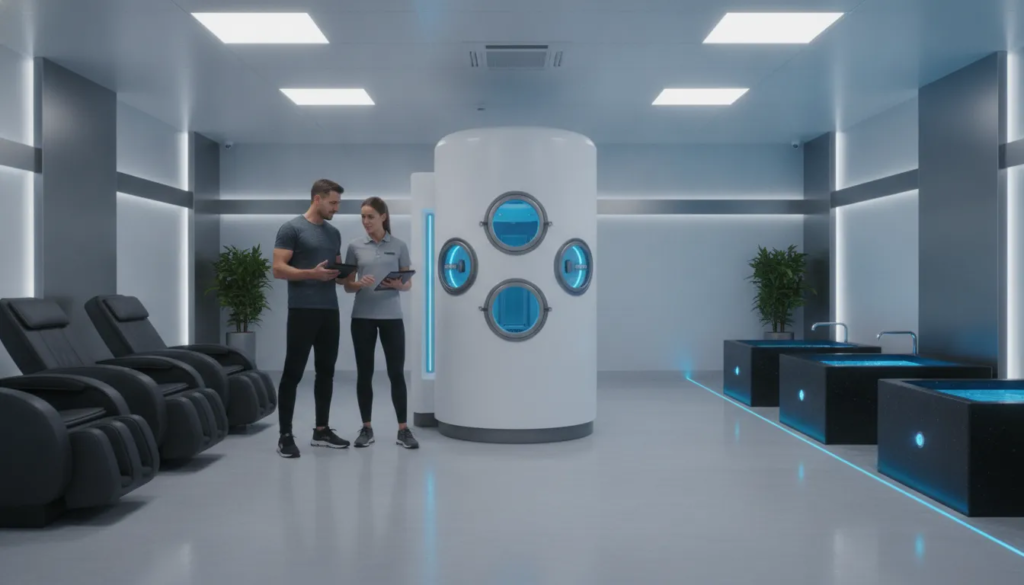
HBOT is a pressurized chamber service that a gym can integrate into its broader recovery and wellness programming. The commercial question is not simply whether the equipment fits in an available room. It is whether the format, member demand, staffing, booking flow, and utilization assumptions can support a credible business case.
HBOT for gyms can be a viable revenue stream when the chamber is planned as part of an operating system. That system should include facility-specific assumptions for capacity, pricing, adoption, staff readiness, and ongoing optimization. It is not a guaranteed payback product or a substitute for disciplined financial modeling.
Start with the operating definition before comparing equipment. A gym needs to understand what the service includes, how it fits the member experience, and which decisions belong in the feasibility model. Review commercial HBOT equipment for gyms for category context, then evaluate the business case on its own terms.
What Does HBOT for Gyms Mean in a Commercial Setting?
HBOT for gyms means evaluating a hyperbaric chamber as part of a managed wellness service. Do not place the equipment in an unused room and hope members adopt it. The commercial question is whether the format, footprint, workflow, staffing plan, and member experience fit the facility’s operating model.
That distinction matters for owner-operators. A gym may have demand for recovery programming, but demand alone does not establish feasibility. The chamber must integrate with existing traffic patterns, staff coverage, booking processes, and the way the facility creates value from each square foot. The business case also needs facility-specific assumptions for utilization, pricing, operating costs, and payback. There is no universal revenue result that applies to every gym.
Equipment is one input into that decision. ROI In Wellness offers both soft-shell and hard-shell hyperbaric chambers, including cylinder and seated configurations. The catalog lists 1.5 ATA and 2.0 ATA 34-inch cylinder formats, plus room-type and 2.0 ATA seated hard-shell options. These examples illustrate available configurations, not a recommendation for every facility. Selection should account for available space, member demographics, operational flow, planned capital allocation, and the intended wellness service model.
The commercial lens is broader than the chamber
A workable plan connects equipment selection to service-menu design, staff readiness, launch planning, utilization tracking, and ongoing optimization. It also identifies who owns scheduling, member onboarding, equipment checks, and escalation procedures. If those responsibilities are unclear, the chamber can become an underused recovery asset rather than a consistent part of the member experience.
The category page for commercial HBOT equipment for gyms provides equipment and configuration context. This article addresses the decision around that category: whether the concept fits the facility, how the operation would work, and which assumptions should be tested before purchase.
Is HBOT Right for a Fitness Facility? Space, Safety, and Readiness
The facility question is larger than whether a chamber can physically fit. An operator must be able to control member flow, assign competent staff, install the equipment correctly, and document what happens before, during, and after each session. The right plan is specific to the individual facility, not copied from another location. Hyperbaric guidance emphasizes that risk management should be adapted to each site and that technical, staffing, and operational competence should be confirmed before opening. Review the facility-safety guidance before finalizing the layout.
Start with flow, not the equipment catalog
Map the complete member journey: arrival, check-in, preparation, chamber entry, monitoring, exit, cleaning, and reset. The chamber should not create a bottleneck beside busy training areas or force members through uncontrolled traffic. Keep walkways free from fall, trip, and slip hazards, and provide a practical waiting location that staff can supervise.
- Reserve space for the chamber, operator position, access paths, and service access.
- Separate waiting and preparation from high-traffic workout zones.
- Plan how a staff member reaches the chamber quickly without crossing the busiest part of the gym.
- Confirm electrical, ventilation, delivery, and installation requirements with the equipment supplier and qualified local professionals.
Some jurisdictions publish detailed planning rules. For example, an Arkansas hyperbaric-suite rule addresses chamber-station capacity, access, reception, staff-controlled waiting areas, grounding, and chamber clearances. One example lists five feet from a chamber to a side wall and six feet between chambers. It also adds passage space for certain end-loading designs. These figures are not universal gym requirements. Use the Arkansas rule as a planning reference, then verify the requirements that apply to your location and chamber type.
Build readiness into the operating model
Hyperbaric environments require disciplined control of ignition sources and flammable materials. Staff should follow documented pre-session checks, inspect personal items as required by the operating policy, and understand the equipment they operate. Written standard procedures should sit alongside an emergency plan covering in-chamber fire prevention, building evacuation, communication, and how occupants will be removed if an incident occurs. Because a pressurized chamber may not be opened immediately, emergency planning cannot rely on rapid door access alone.
Before launch, assign ownership for training, maintenance, inspections, incident reporting, and local approvals. If the team cannot demonstrate that readiness, HBOT may be a poor fit for the current operation even when the available floor area looks adequate.
How Can a Gym Build an HBOT Revenue Model?
Start with capacity, not a promised return. A useful operating model estimates bookable capacity. It then estimates expected sales and the price the business can realistically realize after discounts, packages, and membership benefits.
Core revenue equation: available session capacity x expected utilization x realized price = projected gross revenue.
Define each input for the specific facility. Capacity depends on the chamber format, operating hours, turnover time, staffing coverage, and whether the space serves one member or more than one occupant. Utilization should be modeled as a range rather than a universal benchmark. Build separate assumptions for launch, steady-state, and peak periods. Realized price is the amount the gym actually retains per booked session after introductory offers, package discounts, member credits, and no-shows.
Then map the costs that revenue must support. Fixed questions include equipment financing or purchase, room preparation, installation, insurance, software, and allocated facility space. Variable questions include staffing per operating block, consumables, maintenance, utilities, payment processing, and marketing. The result is not a generic payback promise. It is a facility-specific contribution model that shows which assumptions matter most. ROI In Wellness recommends completing this financial modeling before selecting equipment, including utilization-based revenue projections and payback calculations based on the gym’s own assumptions.
Model more than one offer
A gym can test a service menu with single-session access, multi-session packages, recurring membership add-ons, or premium access tiers. Each option changes realized price, booking behavior, retention value, and administrative workload. Compare the revenue model with the capacity required to deliver it. A membership that looks attractive on paper may create peak-time congestion if booking rules are too loose, while a package may improve commitment without filling every available block.
Use sensitivity analysis before committing
Run conservative, base, and upside cases by changing utilization, realized price, staffing cost, and available operating hours one variable at a time. This reveals whether the business case depends on an aggressive adoption assumption or remains workable under slower member uptake. Track revenue per square foot alongside gross revenue, because a chamber can produce sales while still using valuable space inefficiently.
For a facility-specific starting point, use the ROI Calculator to organize assumptions before comparing equipment formats or finalizing the service menu.
Soft-Shell vs. Hard-Shell HBOT Chambers: Which Fits the Operation?
There is no universally best chamber format for a gym. The right choice depends on the room, member flow, operator, and broader recovery offer. ROI In Wellness offers soft-shell and hard-shell options, including seated and cylinder configurations, so the decision should begin with the operating model rather than a product label.
Operational tradeoffs between soft-shell and hard-shell formats
| Decision area | Soft-shell format | Hard-shell format |
|---|---|---|
| Footprint and layout | Evaluate the available room, access path, clearance, and how the chamber fits beside existing member traffic. | Plan for the equipment envelope, access, clearances, controls, and supporting infrastructure before committing floor space. |
| Workflow | Map setup, entry, supervision, cleaning, and reset steps into the gym’s booking and staffing rhythm. | Map entry, controls, monitoring, cleaning, and reset steps, with special attention to how the unit integrates into scheduled services. |
| Configuration | Consider whether a seated or cylinder configuration supports the intended service menu and member flow. | Consider whether a seated or cylinder configuration supports the intended service menu, room plan, and customer experience. |
| Maintenance and service | Ask about inspection intervals, consumables, cleaning requirements, training, warranty coverage, and service response. | Ask the same questions, plus what installation, utilities, controls, and technical support the site will require. |
| Member experience | Assess comfort, privacy, visibility, communication, and how the format feels within the surrounding recovery environment. | Assess comfort, privacy, visibility, communication, and whether the more substantial equipment presence supports the intended positioning. |
Use the table as a planning prompt, not a substitute for a site review. Chamber type can change technical design, maintenance, and operating practices, so the facility should document its own workflow and service responsibilities rather than copy another operator’s setup. Selection should account for space optimization, facility flow, existing operations, member demographics, planned capital allocation, and facility-specific ROI potential.
A seated hard-shell example can help an operator visualize one implementation path. Review the seated hard-shell chamber format alongside the proposed room plan, staffing model, booking rules, and maintenance agreement before choosing equipment.
How Should Gyms Program HBOT Sessions for Members?
Program the service as an operating system, not an equipment add-on. Start by defining where it fits in the member journey and what business objective it supports. A gym might position HBOT as a premium recovery-room service, a package add-on, or a scheduled component of a broader performance offering. The right choice depends on member demand, available space, staffing coverage, and the utilization assumptions in the facility’s financial model.
Build the service before opening the calendar
Write the menu and booking rules first. Specify who can book, how appointments are requested, how cancellations are handled, what onboarding information is collected, and which staff member owns each handoff. Keep the customer-facing description focused on the experience and operating process. Do not publish wellness promises or prescribe protocols. Technical and safety requirements should come from the equipment manufacturer and qualified professionals.
Onboarding should make the first visit predictable. Give members clear arrival instructions, explain the chamber workflow, identify personal items that cannot enter the environment, and document the staff checklist. Operators should also define escalation paths for questions or unexpected issues before the service launches. The underlying service model should include menu design, pricing, programming schedules, training, launch planning, utilization tracking, and ongoing optimization, rather than treating staff education as a one-time event.
Launch with a controlled test, then manage the numbers
Begin with a limited launch window and a defined member segment. Track booked appointments, completed appointments, cancellations, no-shows, staff time, downtime, repeat interest, and revenue by package or membership type. Those measures show whether the service is earning its footprint and whether the booking process is creating friction. They also create a baseline for capacity and utilization decisions without assuming that another gym’s schedule or pricing will transfer to yours.
Review feedback on a fixed cadence. If attendance is weak, test the offer, booking flow, time slots, or staff explanation before changing equipment assumptions. If demand is strong, confirm staffing and operational capacity before adding availability. Financial projections should remain facility-specific and should be updated as real utilization data replaces estimates.
Frequently Asked Questions
Is HBOT commercially viable for a gym?
It can be, but viability depends on facility-specific assumptions rather than a universal revenue promise. Model available space, expected utilization, realized service price, staffing, installation, maintenance, and member adoption. Compare the projected contribution with the opportunity cost of the space and use sensitivity scenarios before committing equipment capital.
How should a gym choose between soft-shell and hard-shell chambers?
Start with the operation, not the chamber label. Compare footprint, member flow, access, maintenance requirements, service capacity, member experience, planned capital allocation, and the demographics you expect to serve. ROI In Wellness offers soft-shell and hard-shell formats, including seated and cylinder configurations, so the right choice is the one that fits your facility plan and operating model.
What safety and staff readiness steps should a gym complete first?
Before launch, document facility-specific risk controls, operating procedures, emergency and evacuation plans, equipment checks, staff responsibilities, and member screening or intake processes appropriate to the selected equipment. Staff should understand the chamber and associated equipment, and pre-session checks should be completed before operation. Hyperbaric safety guidance emphasizes written emergency procedures and trained operators, including fire-prevention controls (European Code of Good Practice).
How should a gym price sessions and model revenue?
Build the model from capacity and utilization: available appointments multiplied by expected utilization multiplied by realized price, less staffing, maintenance, consumables, financing, and other operating costs. Test membership bundles, packages, and standalone services without assuming every appointment will sell. Facility-specific utilization projections and payback calculations are more useful than a universal session price.
How should gyms program HBOT for members?
Design a clear service menu with booking rules, onboarding steps, staff coverage, launch messaging, and a process for tracking attendance, utilization, member feedback, and operating issues. Do not promise a fixed number of sessions or prescribe a universal schedule. Use early demand data to refine the offer, staffing plan, and pricing while keeping the experience consistent.
Plan the Business Case Before You Buy
HBOT for gyms works best when the equipment choice, member experience, staffing plan, and financial assumptions are evaluated together. Use the ROI Calculator to model your facility’s assumptions, including capacity, utilization, and pricing inputs. If you want a second perspective on the operating plan, book a Strategy Call to pressure-test the model and identify the decisions that need to be resolved before moving forward.