
Commercial Red Light Therapy Equipment for Gyms
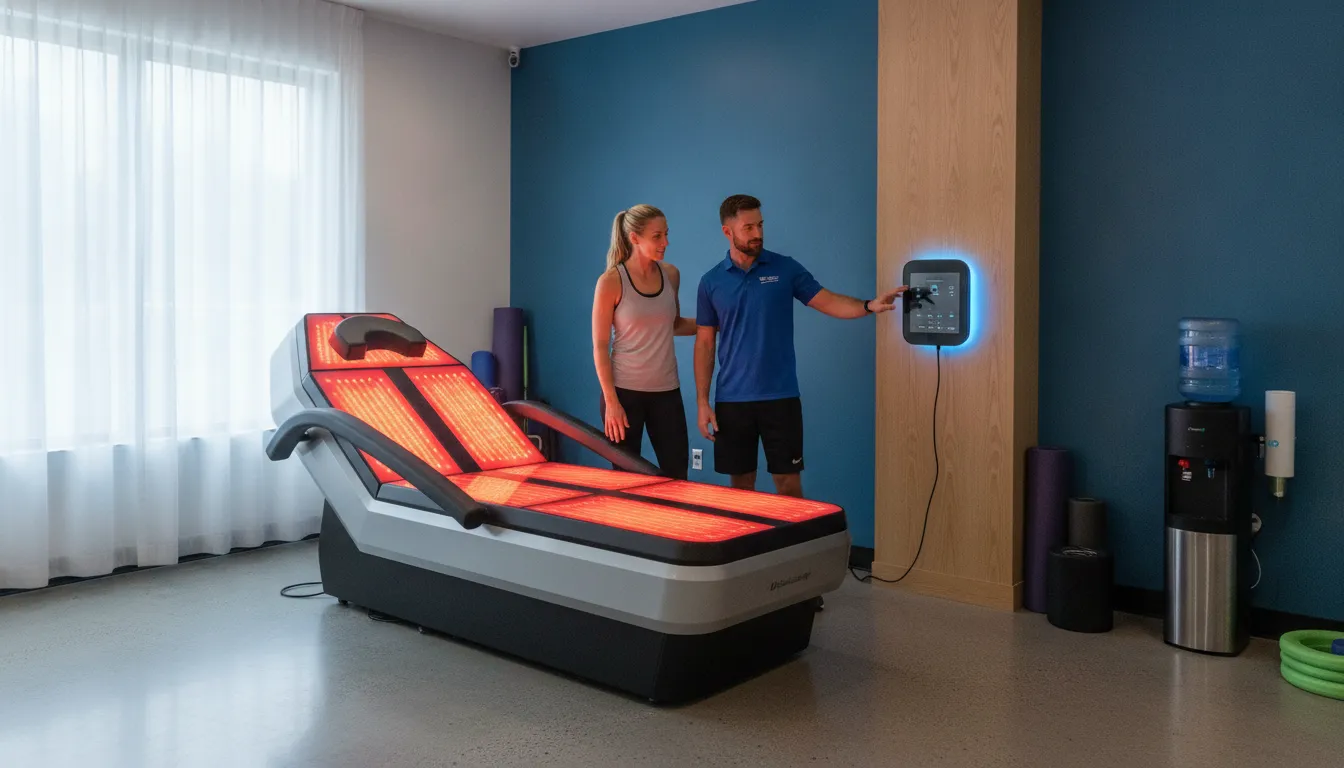
Adding red light therapy to a gym is not primarily an equipment purchase. It is a space, workflow, staffing, and utilization decision that must earn its place in the facility. The right format depends on how members move through the space, what experience you want to create, and whether the operating model can support consistent use.
The best commercial red light therapy equipment for gyms is the system that fits your footprint, member experience, staffing model, and measurable business case. Compare format, specifications, installation requirements, service support, and total operating fit before comparing features or quotes.
Start with ROI, not equipment. A practical buying process connects equipment selection to revenue per square foot, utilization, programming, and staff activation. ROI In Wellness helps operators build commercial wellness systems for gyms around those decisions. The first step is narrowing the available formats to the workflow and experience your facility can execute well.
How to Choose Commercial Red Light Therapy Equipment for Gyms
Format selection should follow the way your gym intends to schedule, staff, and sell the experience. ROI In Wellness evaluates equipment by ROI potential, space optimization, operational integration, member demographics, and investment parameters, rather than treating a specification sheet as a buying decision. The lineup spans portable, wall-mounted, reclined, enclosed-pod, 360-degree bed, and professional system formats.
Commercial red light formats compared by facility fit
| Format | Footprint and placement | Workflow and throughput considerations | Best fit for an operator |
|---|---|---|---|
| Portable | Flexible placement and easier reconfiguration when floor plans change. | Supports shared spaces, but staff must manage setup, positioning, and storage consistently. | A gym testing demand or programming the modality across multiple areas. |
| Wall-mounted | Uses vertical space and can preserve valuable floor area. | Creates a repeatable station with less setup between scheduled users. | A facility that wants a defined recovery zone without dedicating space to a large enclosure. |
| Reclined | Requires room for the station, user access, and comfortable circulation. | Encourages a more structured, appointment-based experience and clear turnover procedures. | An operator designing a deliberate member experience around a seated or reclined session. |
| Enclosed | Needs a dedicated footprint and careful attention to entry, clearance, and cleaning access. | Provides a consistent, private workflow, but may require more operational planning. | A gym with a defined wellness room and a service model built around scheduled sessions. |
| Standing | Designed around an upright footprint and straightforward user access. | Can support a quick, repeatable station workflow when placement and scheduling are clear. | A facility prioritizing efficient circulation and an easy-to-understand station format. |
| Full-body | Typically demands the most deliberate floor planning, access, and equipment clearance. | May create a premium, appointment-led experience with more involved turnover procedures. | An operator with sufficient space and a business case for a dedicated full-body destination. |
Use the commercial red light therapy equipment category to review the available formats. Then compare a commercial red light therapy bed with a standing red light therapy cabin against your actual floor plan and service workflow. The right choice is the format your team can activate consistently, not necessarily the largest system or the most feature-rich option.
What Power Output, Wavelength, and Dose Should Operators Compare?
Specifications only help when vendors report them in comparable terms. Ask each manufacturer to define wavelength range, output, irradiance, session duration, and the measurement method behind each figure. A number without units, test setup, or distance from the light source is not a useful purchasing input. It may describe the device, but it does not tell your team how the equipment will be configured, scheduled, or explained to members.
Request a complete operating profile
Wavelength information should identify the actual bands available, not simply say that a system uses red and near-infrared light. Manufacturers may describe wavelength selections differently, so require each shortlisted vendor to provide a complete, model-specific specification sheet. Ask for the exact bands available, what settings are selectable, and whether those settings apply to the configuration being quoted. Treat any figures as purchase inputs only after reviewing the official documentation for the exact model, rather than assuming a larger count or broader range is better.
Also ask for irradiance at the intended operating distance, how the value was measured, and whether it applies across the full usable area or only at the source. If the vendor uses the word dose, request the calculation and session assumptions. In practical terms, dose documentation should let an operator connect output, exposure time, positioning, and repeatable settings. A control panel that stores presets, identifies remaining session time, and limits staff guesswork can be more valuable than an impressive headline specification.
Separate documentation from performance promises
Build a written specification sheet for every shortlisted system. Include selectable settings, timer controls, user positioning, cleaning requirements, electrical needs, staff instructions, and the exact claims the vendor permits your business to make. The U.S. Food and Drug Administration guidance on photobiomodulation devices addresses testing and labeling recommendations for specified light-based devices. Some products intended only for general wellness may fall outside that guidance’s scope. That distinction is a reason to ask for the manufacturer’s intended-use statement and substantiation file, not a reason to imply efficacy.
For operators comparing a more enclosed format, review the red light therapy capsule using the same checklist. The strongest choice is the system whose documented settings, controls, staff workflow, and allowed messaging fit your facility. Start with repeatability and operating fit, then evaluate the rest of the equipment stack.
Commercial Red Light Therapy Equipment for Gyms: Space and Infrastructure
Space planning should begin before an equipment quote is approved. The right footprint is not simply the product’s stated dimensions. It includes the operator’s working clearances, member movement, delivery route, cleaning access, and the infrastructure needed to keep sessions consistent during a busy gym schedule.
- Measure the usable footprint. Map the proposed equipment location, then add the clearances required to open, enter, exit, clean, and service the system. A product listing’s stated dimensions are only the equipment envelope, and that measurement alone does not define the room it needs. Treat published dimensions as a starting point, not a final floor plan. A couch-format red light equipment layout may support a different traffic pattern than a standing or enclosed format.
- Trace member traffic. Mark the approach, session queue, check-in point, and exit path. Keep the station out of pinch points and avoid forcing members or staff to cross an active training lane. Consider whether a person can reset the space without interrupting the next session.
- Confirm electrical requirements. Have a qualified installer review the site before purchase. Electrical requirements vary by model and configuration. Ask each vendor to provide voltage, amperage, circuit, disconnect, and hardwiring requirements for the exact system being quoted, then confirm capacity and local code with a qualified installer before purchase.
- Validate delivery and surfaces. Measure doors, corridors, turns, elevators, and staging areas. Confirm whether the equipment can be assembled inside the facility. Review flooring, levelness, load considerations, and protection from moisture before delivery is scheduled.
- Plan the operating workflow. Decide where cleaning supplies, towels, controls, and consumables will be stored. Document who resets the station, when it is cleaned, how faults are reported, and which maintenance tasks staff can perform. Ask the vendor to identify service access and recommended maintenance intervals before committing to the layout.
Installer confirmation turns a promising product fit into an implementable one. It also protects valuable square footage from a late discovery that changes the room, electrical plan, or member flow.
How Should a Gym Price Red Light Therapy Sessions?
There is no universal session rate that works for every gym. Pricing should begin with the operating model: available capacity, expected utilization, staffing requirements, member access, and the role the service plays in your broader wellness category. The objective is not to copy another facility. It is to create a price architecture that supports a credible contribution margin while fitting your members’ expectations and your team’s workflow.
Start by defining usable capacity. Count the sessions the equipment can realistically support during your operating hours, then apply a conservative utilization assumption rather than treating every open slot as a sale. Account for setup, cleaning, transition time, maintenance, and periods when staff cannot actively support the experience. A price that looks attractive on paper may still underperform if the format creates bottlenecks or requires more labor than expected.
Book a Strategy Call to pressure-test the operating assumptions before you commit to a pricing structure.
Build access around the member relationship
Decide whether sessions are sold as a standalone service, included in a higher-tier membership, offered through a recurring add-on, or packaged with complementary recovery experiences. Each model changes the value exchange and the demand pattern. Standalone access can make utilization easier to measure. Membership access may support retention and routine, but it requires clear limits so demand does not exceed practical capacity.
Packages should have a defined purpose. A limited introductory package can help staff learn the workflow and reveal demand. Recurring access can support predictable scheduling. Multi-modality packages can position red light within a larger recovery experience, provided the combined delivery time, staffing, and space requirements are understood. Avoid discounting simply to generate volume. The relevant question is whether the package improves contribution margin and productive use of the room.
Model contribution margin and sensitivity
Separate gross session revenue from contribution margin. Include payment processing, consumable supplies, incremental labor, service agreements, financing costs, and the share of space required to deliver each session. Then test the model under different utilization, staffing, and package-mix assumptions. This sensitivity view is more useful than a single payback estimate because it shows which operating variable matters most.
Use the ROI Calculator to organize the assumptions and compare scenarios before selecting equipment. The broader implementation framework connects pricing to category design, complementary equipment, staff activation, programming, and measurement. Review actual utilization and revenue per session regularly, then adjust access rules or programming based on observed behavior rather than initial expectations.
How Do You Compare Commercial Red Light Therapy Manufacturers?
A manufacturer comparison should test the operating relationship, not just the equipment specification sheet. For a gym evaluating these systems, ask whether the vendor can support your facility before delivery, during installation, and after staff begin serving members.
Define the warranty in operational terms
Ask what the warranty covers, what it excludes, and whether labor, parts, shipping, and on-site service are included. If a vendor presents a multi-year warranty, ask for the full written terms and confirm that they apply to the exact commercial configuration being quoted. Compare coverage for the main system, controls, power components, and wear items. Also ask whether a professional-use warranty differs from a standard consumer warranty.
Test the service and support model
Request the expected response time for a technical issue, the support channels available to staff, and the escalation process when remote troubleshooting is not enough. Ask who owns the relationship after the sale. Is support handled by the manufacturer, a distributor, a regional technician, or a third-party service network?
Clarify installation, training, and documentation
Do not assume installation is included because one vendor listing includes it in a particular market. Ask for a line-item scope covering delivery, placement, assembly, electrical coordination, commissioning, and removal of packaging. Confirm who verifies site readiness and what happens if the delivery path or facility infrastructure requires changes.
Training should cover controls, cleaning workflow, session setup, basic troubleshooting, and staff handoff. Ask for operator manuals, maintenance schedules, wiring information, and replacement-part guidance. If a listing references ETL or UL standards, request the applicable certification or documentation and confirm that it applies to the exact configuration you are buying.
Compare lead times and controls before signing
Get a written lead-time range, identify what could delay fulfillment, and ask when the clock starts. Review the control interface, preset management, session records, and access permissions in a live demonstration. A system may look attractive on paper but create friction if staff cannot set it up consistently during peak traffic.
For a wall-mounted format, review the wall-mounted red light system alongside your installation and workflow requirements. The best manufacturer is the one whose equipment, documentation, service model, and implementation scope fit the business you are actually building.
What Should the ROI Model Include Before You Buy?
Start with the business case, not a product catalog. For boutique studios and mid-market gyms, the model should show how a red light category fits the facility, member journey, and operating plan. This audience often includes one to five locations and roughly 1,000 to 5,000 square feet. The goal is not to promise a result. It is to expose the assumptions that must be true for the investment to make sense.
1. Validate demand before selecting equipment
Define who will use the service, what problem in the member experience it addresses, and when sessions fit into the existing schedule. Review member demographics, current recovery or wellness interest, available square footage, and the staff capacity to introduce a new offering. If demand depends on a new audience or an untested price point, label that as a risk in the model rather than treating it as guaranteed utilization.
2. Design the category, then select the stack
Decide how the category should be positioned inside the gym. Is it a standalone service, a component of a recovery pathway, or part of a broader wellness membership? That choice affects format, footprint, throughput, and the complementary equipment that belongs around it. Equipment curation should account for ROI potential, space optimization, operational integration, member demographics, and investment parameters. A single impressive unit may be less useful than a complementary stack that supports more workflows.
3. Build the operating and pricing plan
Document the session flow from booking and check-in through cleaning, turnover, and follow-up. Assign staff ownership, create programming and onboarding language, and define how the service will be introduced without making unsupported wellness claims. Model pricing with realistic capacity, staffing time, expected utilization, operating costs, and contribution margin. Separate assumptions from known costs so the model can be updated as vendor scope and installation requirements become clearer.
4. Measure utilization and revenue per session
After launch, track booked sessions, completed sessions, cancellations, average revenue per session, staff time, and revenue per square foot. Compare actual performance with the original assumptions at a defined review interval. If utilization is weak, test programming, scheduling, positioning, or staff activation before adding equipment. A disciplined measurement loop turns commercial red light therapy equipment for gyms into an operating decision, not a one-time purchase.
For a facility-specific review of the assumptions, contact ROI In Wellness with your floor plan, operating model, and category objectives.
Frequently Asked Questions
What red light equipment format fits a commercial gym best?
Choose the format that matches your available footprint, member flow, staffing model, and intended experience. Wall-mounted systems can preserve floor space, while reclined, enclosed, standing, and full-body formats may support a more dedicated recovery environment. Start with workflow and utilization, then select the equipment.
What should I confirm before approving installation?
Confirm the measured footprint, required clearances, delivery path, flooring, ventilation, cleaning process, and electrical requirements. Ask the vendor for written specifications and have a qualified installer verify circuit capacity before ordering. Installation scope should clearly identify what the vendor includes and what your facility must provide.
How should a gym set session pricing?
Build pricing from the experience you are offering, expected demand, available capacity, staffing, operating costs, package structure, and contribution margin. Test the assumptions in a model before publishing rates. Avoid treating a vendor’s projected utilization or payback as a guaranteed business result.
How do I compare red light equipment vendors fairly?
Compare more than LED counts or feature lists. Review warranty coverage, service response, installation, training, controls, documentation, lead times, replacement parts, and post-sale support. Ask each vendor to define exclusions and ownership responsibilities in writing so the comparison reflects total operating fit.
When should I add red light equipment to a larger wellness stack?
Consider a broader stack when your demand, space, programming, staffing, and measurement plan support it. Model the category first, then evaluate complementary equipment and the role each modality plays in the member experience. A smaller, well-activated system is stronger than equipment that occupies space without a clear operating purpose.
Book a Strategy Call for Your Gym
Choosing commercial red light therapy equipment is easier when the equipment, space, programming, and business model are evaluated together. If you want a clearer path from equipment selection to implementation, Book a Strategy Call with ROI In Wellness to discuss the right next steps for your gym.