
Commercial HBOT Chamber for Gyms: 3-Modality Guide
Buying a commercial HBOT chamber for gyms is not a matter of choosing the most impressive machine in a catalog. The real decision is how a hyperbaric chamber, red light therapy equipment, and an infrared sauna will fit your room, staffing model, member journey, and revenue plan. This guide gives owner-operators a practical way to compare the three modalities before committing capital.
ROI In Wellness approaches the purchase as a business-system decision. Equipment is only one part of the investment. Layout, booking flow, staff training, pricing architecture, maintenance, and utilization determine whether a recovery area becomes a productive profit center or an expensive room that members rarely use.
What must a commercial HBOT chamber for gyms accomplish?
A commercial HBOT chamber for gyms must deliver a dependable, well-documented member experience while fitting the facility’s space, access route, staffing, and utilization plan. The right chamber is not simply the unit with the highest specification. It is the unit the team can operate consistently, service responsibly, and schedule without creating a bottleneck.
Start with the operating brief, not the product page. Write down the role the chamber is expected to play:
- Will it support a premium recovery-room membership, paid sessions, personal-training packages, or a mix?
- Will one staff member supervise the room, or will the workflow require a dedicated operator?
- How many sessions can the team realistically schedule during peak periods?
- What level of privacy, comfort, communication, and turnaround does the facility want to deliver?
- Which documented procedures must be completed before the first member session?
These questions expose the difference between a product purchase and a commercial program. A chamber with a compact footprint may be a strong fit for a boutique facility with limited floor area. A larger hard-shell system may make more sense for a high-volume operator that has planned delivery access, dedicated room capacity, and a repeatable staffing process.
ROI In Wellness lists commercial HBOT configurations in several formats through its commercial HBOT equipment collection. Review those options by pressure specification, capacity, room requirements, support, and total operating fit, rather than treating the listed price as the complete investment.
How do HBOT, red light, and infrared sauna equipment differ?
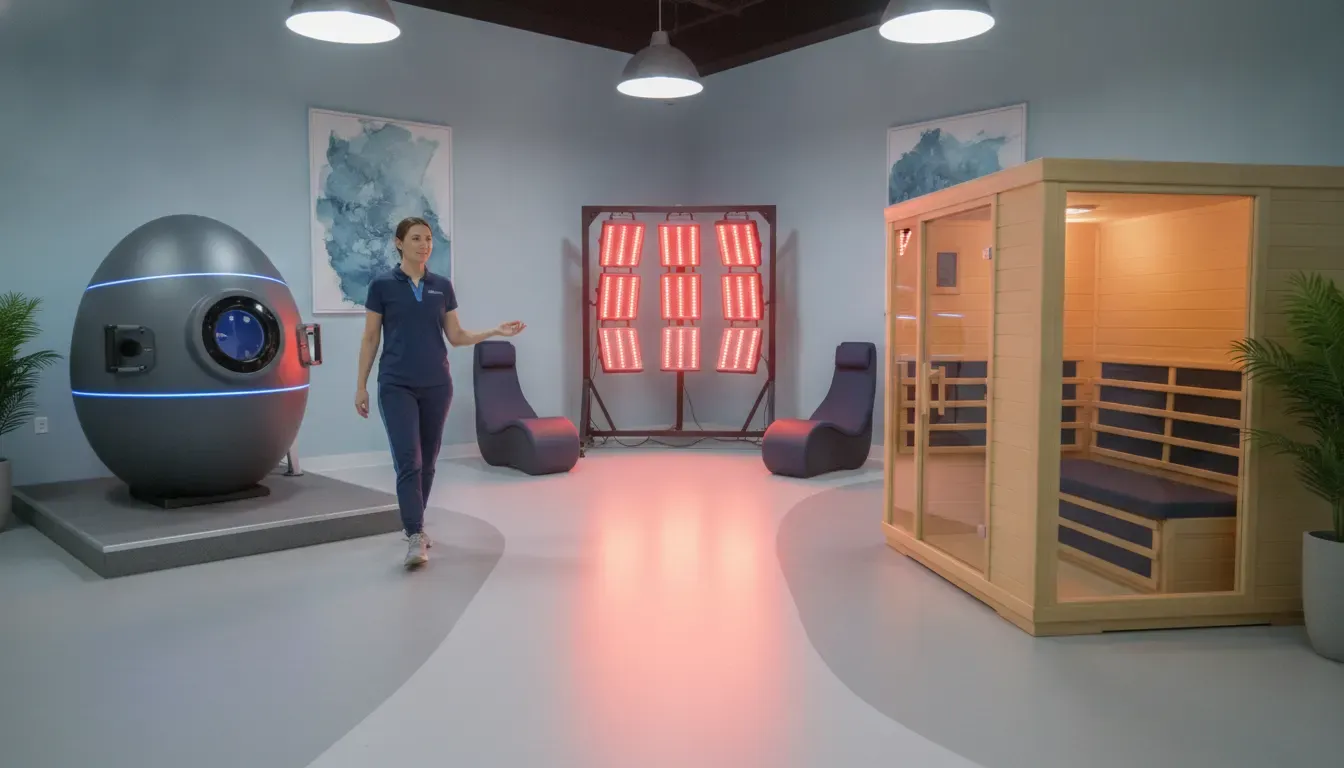
HBOT, red light therapy, and infrared sauna equipment solve different operating problems. HBOT can serve as a high-consideration anchor modality; red light equipment can offer flexible formats and a wide range of footprints; an infrared sauna can create a familiar, appointment-friendly experience. Each requires a different room, staffing, cleaning, and capacity plan.
| Modality | Primary buying question | Operational focus | Commercial fit |
|---|---|---|---|
| HBOT chamber | Can the facility operate the chamber safely and consistently at the planned volume? | Room access, pressure system, communication, procedures, supervision, maintenance | Premium anchor service where the operator can support a disciplined workflow |
| Red light therapy | Which format creates the right balance of footprint, session flow, and member experience? | Panel or enclosure format, positioning, cleaning, eye comfort, timer controls, turnover | Flexible pilot or scalable recovery-room component |
| Infrared sauna | Can the room support commercial duty cycles, heat management, and predictable turnover? | Electrical planning, ventilation, materials, cleaning, room temperature, scheduling | Accessible anchor or stack component for a broader recovery offer |
ROI In Wellness organizes its commercial red light therapy equipment in multiple form factors, including mobile, wall, capsule, bed, and standing cabin options. That range matters because the same modality can support very different business models. A wall or mobile unit may suit a measured pilot, while an enclosed bed or cabin may support a more premium room design.
On the sauna side, verify that the equipment and installation plan are intended for commercial use. Residential assumptions often fail when the room has frequent daily turnover. Ask about duty cycle, electrical load, ventilation, cleaning materials, replacement parts, service access, and the time needed to reset the space between appointments.
How do chamber configurations change the operating model?
Chamber configuration changes more than the number of people who can use the equipment. It affects room size, delivery planning, session scheduling, supervision, privacy, cleaning, and the way the service is positioned. Compare configurations against the intended program instead of assuming that higher capacity automatically creates higher return.
A single-seat chamber may suit an operator that wants a controlled premium service, has limited room capacity, or wants to learn demand before adding a second unit. The tradeoff is that one appointment occupies the system at a time, so the program depends on reliable bookings and a clear turnover process. Model the staff time required for orientation and reset, not only the time under pressure.
A larger or multi-person chamber can create more capacity, but the facility must be prepared to fill that capacity. It may require more floor area, a stronger delivery plan, greater attention to privacy, and a more deliberate group scheduling policy. If the demand model is uncertain, the additional capacity can increase capital exposure without improving utilization.
Hard-shell construction, integrated systems, seating, viewing access, controls, and support packages can change the ownership experience. Ask the supplier to separate core equipment from site work and optional additions. Confirm which functions are included, which must be installed by a qualified contractor, and which tasks the facility team must perform daily.
For every configuration under consideration, make a one-page decision sheet with these fields:
- Room footprint plus service and circulation clearance
- Delivery route, door measurements, and installation access
- Capacity and complete appointment block, including orientation and reset
- Staff role during the session and coverage during peak demand
- Documentation, training, cleaning, maintenance, and escalation requirements
- Warranty, parts, service response, and downtime plan
- Offer structure, expected use case, and minimum viable utilization
This decision sheet turns a sales conversation into an operating comparison. It also gives the owner a record to share with facilities, finance, insurance, and the team responsible for launching the room.
How does an infrared sauna fit a commercial recovery room?
An infrared sauna can serve as an approachable component of a commercial recovery room when its installation, room reset, and booking flow are designed for repeated daily use. The key questions are electrical capacity, ventilation, heat management, durable materials, cleaning access, session turnover, and how the room connects to the rest of the member journey.
Place the sauna where heat, humidity, and traffic can be managed without disrupting adjacent equipment. Confirm whether the room needs dedicated ventilation, whether nearby surfaces can tolerate the operating environment, and how staff will clean the interior between appointments. A beautiful wood enclosure does not replace a written reset procedure.
Define the session experience before selecting the format. Decide whether the sauna is booked on its own, included in a membership, paired with red light, or used as part of a broader recovery sequence. If the customer journey requires moving between several rooms, account for transition time and staff instructions. If the modalities share a room, use clear zones so the sauna does not become a visual or circulation bottleneck.
Measure adoption with the same discipline used for other equipment. Track available blocks, completed sessions, repeat use, room reset time, cancellations, member questions, and maintenance issues. The sauna can become a dependable part of the program when the offer is simple, the room is comfortable, and the team can maintain it without disrupting other services.
What should operators evaluate before buying commercial equipment?
Operators should evaluate commercial recovery equipment across six connected areas: footprint, throughput, infrastructure, team workflow, member experience, and vendor support. A product that looks strong in isolation can still underperform if it cannot reach the room, cannot turn over quickly, or leaves staff without a clear operating process.
1. Footprint and delivery access
Measure more than the room where the equipment will sit. Map the route from the loading area to the final room, including doors, turns, elevators, thresholds, and clearance for installation. Confirm floor loading, ceiling height, electrical panel location, and the space needed for service access. A chamber or sauna that fits on a floor plan may still be impossible to deliver through the building.
Leave enough room for the actual member journey. Staff need to greet the member, explain the session, complete the opening checks, and reset the area without blocking the next appointment. Recovery rooms feel premium when the circulation is calm and obvious. They feel improvised when every handoff requires moving furniture or crossing another member’s space.
2. Throughput and peak-hour demand
Throughput is the number of completed sessions the system can support after setup, explanation, cleaning, and reset time are included. Do not calculate capacity from the equipment’s session duration alone. Use the full booking block, then model weekday mornings, after-work demand, weekends, and the staffing coverage available during each period.
For a one-unit pilot, the practical question is not how many sessions are theoretically possible. It is how many sessions the team can deliver with a consistent experience. If the equipment needs a long turnover, a dedicated room, or a trained staff member for each appointment, those requirements belong in the capacity model from day one.
3. Infrastructure and installation
Request a written installation checklist before approving a purchase. Confirm electrical requirements, ventilation, temperature management, network or control needs, delivery dimensions, floor requirements, and any manufacturer-specific site preparation. For HBOT, request the full equipment documentation and operating procedures. For red light equipment, confirm mounting, positioning, controls, and cleaning access. For infrared sauna equipment, confirm heat, ventilation, electrical, and material requirements.
Bring the contractor, facilities lead, and insurer into the conversation early. Their questions are part of the buying process, not an obstacle after the purchase. A clear pre-installation review protects the schedule and helps the owner understand the complete scope of the investment.
4. Safety, documentation, and staff readiness
Commercial operators need a documented process that staff can follow without improvising. Ask the supplier for operating manuals, maintenance schedules, emergency procedures, cleaning instructions, training coverage, and escalation contacts. Establish what the facility will explain to members, what staff will observe, when a session should stop, and how the event will be recorded internally.
Do not let a sales label substitute for documentation. Terms such as commercial, premium, or advanced do not tell you how the system will perform in your room. Review the actual procedures, support commitments, warranty terms, and parts process. If the supplier cannot answer basic operating questions before the sale, the ownership experience is unlikely to become easier after delivery.
5. Member experience and positioning
The room should make the value of the service easy to understand without overpromising. Define the audience, the offer, the session flow, and the language staff will use. A premium member may value privacy, a calm room, simple booking, and a consistent routine more than another feature on the equipment specification sheet.
Keep the positioning centered on recovery, performance support, relaxation, and the overall member experience. Avoid claims about diagnosing or resolving individual wellness concerns. The facility’s commercial advantage comes from a well-run service and a clear reason to return, not from promises the operator cannot responsibly support.
6. Vendor support and total ownership
Compare the supplier relationship as carefully as the machine. Ask who handles installation questions, how parts are sourced, what technical support looks like, how training is delivered, and what happens if a key employee leaves. Review warranty coverage, service response expectations, preventative maintenance, consumables, and the process for a unit that is temporarily unavailable.
For a commercial operator, downtime is more than an inconvenience. It can disrupt bookings, frustrate members, and reduce trust in the recovery program. Support quality belongs in the purchase decision because it affects utilization and the amount of internal time needed to keep the equipment productive.
How much should a commercial operator plan to invest?
Plan the investment as a complete launch model rather than a single equipment line. Include equipment, delivery, installation, electrical work, room preparation, training, insurance review, booking software, maintenance, staff time, financing costs, and launch marketing. Then compare that total with a conservative utilization model that uses real facility demand instead of optimistic assumptions.
The live ROI In Wellness HBOT category has displayed listed examples from $27,500 to $45,900 across several configurations, while the red light category has displayed options from $4,200 to $38,900. These are current site examples, not a universal quote or a promise of final project cost. Confirm availability, specifications, installation scope, and pricing before using any figure in a capital plan.
For the wider target market, ROI In Wellness commonly works with boutique studios and mid-market gyms planning $50,000 to $300,000 in wellness equipment investment. That range is broad by design. The right plan may start with one modality and a measured pilot, or it may require a coordinated room build across several equipment types.
Use this simple model for each modality:
- Available capacity: realistic sessions per operating day after setup and reset time.
- Utilization: the percentage of available appointments filled by paying or included members.
- Average realized price: the actual amount collected after packages, memberships, and promotions.
- Direct operating cost: staff time, cleaning, consumables, utilities, maintenance, and payment costs.
- Contribution: realized revenue minus direct operating costs, before fixed facility expenses.
- Payback view: total launch investment divided by a conservative monthly contribution, with sensitivity for slower adoption and downtime.
Do not use a revenue projection as the business case by itself. Test at least three cases: a cautious launch, a likely operating case, and a strong demand case. If the plan only works in the strongest case, change the equipment mix, the room design, the offer, or the launch sequence before ordering.
For a second-pass model, use the ROI Calculator to test utilization and payback assumptions. The calculator is a planning tool, not a guarantee. The quality of the output depends on the assumptions entered, so keep the scenario conservative and document what would need to be true for the plan to work.
Should a gym start with one modality or a full recovery stack?
Start with the smallest equipment mix that can prove demand and support a coherent member journey. A single modality is easier to staff and measure, while a coordinated stack can raise the value of the room when the facility already has demand, space, and operational maturity. The decision should follow the business model, not a trend.
| Starting point | When it fits | What to prove first |
|---|---|---|
| One red light unit | Limited space, interest in a flexible pilot, or a room that needs a lower-complexity entry point | Bookings, repeat use, cleaning time, offer clarity, and staff workload |
| One infrared sauna | Existing demand for a simple scheduled room experience and adequate electrical and ventilation planning | Turnover, peak-hour demand, room comfort, and maintenance rhythm |
| One HBOT chamber | Clear premium positioning, strong operator commitment, and room plus staff capacity for disciplined procedures | Demand quality, booking reliability, training readiness, and support response |
| Multi-modality room | Existing recovery demand, enough square footage, and a team ready to manage several service flows | Cross-use between modalities, package design, member navigation, and room utilization |
A stack should feel intentional. The member should understand which modality fits the moment, how to book it, what the session includes, and what happens next. Build the room around a simple path such as arrival, orientation, session, reset, and follow-up. A strong layout can make several equipment types feel like one program instead of unrelated machines.
Review fitness center recovery room design principles before you finalize the layout. The design decision affects every later metric: how many appointments the team can deliver, how long cleaning takes, how private the experience feels, and how much revenue the room can produce per square foot.
How should operators launch the program?
Launch in stages. Define the offer, prepare the room, train the team, open a controlled booking window, and review real utilization before expanding. The first launch is not a publicity event. It is a test of whether the equipment, space, staff, and member journey work together under normal operating pressure.
- Define the commercial objective. Decide whether the program is designed to create a new paid service, support a premium membership, improve retention conversations, or differentiate the facility in a specific category.
- Choose the audience. Start with a clear member segment and a clear use case. Avoid trying to sell every modality to every person on the first day.
- Write the operating playbook. Include opening checks, member orientation, session timing, cleaning, room reset, maintenance logs, escalation, and staff handoffs.
- Train the team on one explanation. Staff should describe the equipment accurately, use approved language, and know when to pause the session or escalate a question.
- Open a controlled schedule. Start with enough appointments to learn, not so many that the team cannot deliver a calm experience.
- Review the first operating period. Track demand by day and time, cancellations, repeat bookings, staff questions, cleaning time, downtime, and member feedback.
- Adjust before expanding. Change the offer, room flow, pricing structure, or staff coverage before adding another unit.
ROI In Wellness supports this type of business-first implementation through equipment curation, room planning, training, and revenue strategy. Its business overview explains the broader approach: start with the operator’s goal, then connect equipment, activation, and measurement into one system.
Which metrics show whether the equipment is working?
Track operational metrics before declaring success. Utilization, realized revenue per appointment, repeat booking rate, cancellation rate, staff minutes per session, downtime, cleaning time, and contribution after direct costs show whether the program is becoming dependable. Retention conversations and package adoption can add context, but they should not replace equipment-level data.
Use a simple weekly scorecard:
- Available appointment blocks versus completed sessions
- Utilization by modality, day, time, and member type
- First-time sessions versus repeat sessions
- Average booking value after package or membership adjustments
- Staff time per completed appointment
- Cleaning and reset time, including exceptions
- Equipment downtime and unresolved service requests
- Contribution after direct operating costs
- Member questions, objections, and reasons for returning
Review the scorecard with the team, not just with finance. Staff often see the friction first: a confusing booking rule, a room that takes too long to reset, or an explanation that creates the wrong expectation. Fixing those details can increase productive capacity without buying more equipment.
When the data is stable, use it to refine pricing, package design, staffing, and expansion. A second unit should be justified by a pattern of demand and a clear operational reason, not by the assumption that more equipment will create demand by itself.
What should commercial operators ask a supplier?
Ask a supplier to connect every recommendation to the facility’s room, staff, member journey, and financial model. A trustworthy buying conversation should cover specifications, installation, documentation, support, training, warranty, maintenance, and the assumptions behind any utilization or payback discussion.
- Which configuration matches our available room, access route, and target throughput?
- What site preparation is required before delivery?
- What documentation and training are included?
- Which daily and preventative maintenance tasks belong to our team?
- What parts, service contacts, and response expectations apply after installation?
- What is the full project scope beyond the equipment invoice?
- Which assumptions support the recommended utilization model?
- How can the program expand if demand is proven?
The supplier should be comfortable discussing tradeoffs. A vendor-neutral partner can help compare equipment across manufacturers and choose the configuration that fits the operator’s constraints, rather than forcing the facility into a single product line.
For a focused HBOT review, compare the product details and operating questions in ROI In Wellness’s hyperbaric chamber guide for gym operators. For red light planning, review its commercial red light therapy equipment guide. Those narrower resources support this pillar without replacing the three-modality planning framework here.
Frequently asked questions
Is a commercial HBOT chamber a good fit for every gym?
No. The fit depends on room access, staffing, documentation, insurance review, demand, and the operator’s ability to deliver a consistent process. A gym should confirm the complete installation and operating scope before choosing an HBOT chamber. A smaller or simpler modality may be the more practical first step when space or staff coverage is limited.
How do I choose between HBOT and red light therapy equipment?
Compare the desired member experience, room capacity, staffing burden, throughput, service model, and investment scope. Red light therapy often offers more format flexibility, while HBOT can serve as a higher-consideration anchor modality. Neither should be selected from specifications alone. Model the full workflow and the audience each offer is intended to serve.
What makes an infrared sauna commercial-ready?
Commercial readiness includes duty-cycle suitability, electrical planning, ventilation, durable materials, cleaning access, service support, and controls the team can operate consistently. Ask for installation requirements and maintenance expectations in writing. Do not assume a residential unit will perform reliably in a room with frequent daily turnover.
How many recovery equipment units should a new program start with?
Start with the smallest mix that can deliver a coherent offer and create useful operating data. One unit can prove demand, staff workflow, and repeat use. Add capacity when the booking pattern, contribution, and room flow show a clear need. A larger stack is not automatically a stronger business case.
What should I include in the equipment investment model?
Include equipment, delivery, installation, electrical work, room preparation, training, staff time, maintenance, utilities, insurance review, booking tools, financing costs, and launch activity. Then model realistic utilization and direct operating costs. Keep a cautious case in the plan so the decision does not depend on a perfect launch.
Where can I get help planning a commercial recovery room?
ROI In Wellness helps operators connect equipment selection with space planning, training, pricing, utilization, and revenue strategy. Use the contact page to request a strategy conversation, or use the ROI Calculator to organize the first financial assumptions before the call.